iSite: Greenbriar
Biomimicry iSite notes about the mechanisms used by a climbing plant
January 19, 2025
February 17, 2026
Updated:
Created:
Assumed Audience
Designers looking for inspiration, interested in Biomimicry, or just learning new things about the world around us
Epistemic Status
I'm definitely not a biologist, so I'll likely get some things wrong here. My approach to iSites is to learn more and have them inform future design ideas and problem solving.
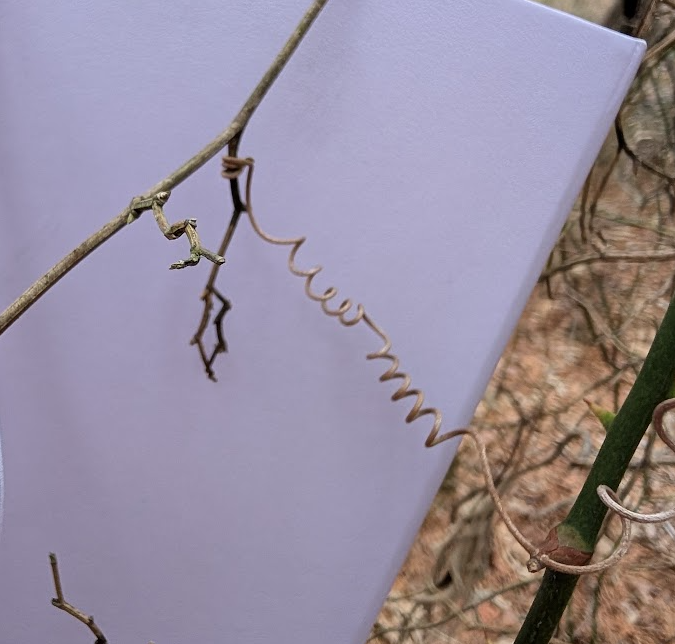
Came across this climbing plant:
- Dark, warm green stalk/ stem
- Thorns at even intervals
- Each segment of thorns is separated by a protrusion that casts out a small supporting structure that the plant uses to wrap around other neighboring plants, allowing it to climb.

Support structures are very sturdy and hold the shape they’ve grown into after I gently released one from a branch. They seem to grow/wrap/spin counter-clockwise. When they don’t connect to a branch, they just sort of spin out. The plant seems to prioritize growth efforts to spirals that are connected to something, loose supports are much more brittle.
This is a Common Greenbriar (Smilad rotundifolia). In doing a bit of research, the briars will form thickets if they don’t find something to hold on to, and those thickets can be used as cover for birds and small mammals. They’re also edible! And are a host plant for various moth species.

Life’s Principles
I feel like the two principles that jump out immediately to me are that it’s adapting to changing conditions by choosing where to attach its supports, and how they wind around other structures. And the other being that it integrates growth with development. Because it relies on these tendrils to grow upwards, it must organize the supports before its growth can be sustained in that direction.
Biomimicry Taxonomy
Stays Put via Attaching to neighboring structures with support tendrils that wrap around those structures. Those tendrils also Protect From Physical Harm by Preventing Structural Failure, and by Modifying Physical State.
Mechanism
The Greenbriar creates tendrils which it uses to support climbing growth by wrapping around neighboring structures like other plants’ branches.
Strategy
Use winding tendrils as support structures for climbing growth
Function
Attachment to other structures for support
Debiologized Design Principle
Support structures that wrap or wind around neighboring structures.
What are iSites?
These are activities or opportunities for reconnecting with nature through intentionally slowing down and observing the things around you. And also just a great reason to be outside!
Check out this post here for a little more about them and how to get started with the practice!